
Hot Forming (glass)
Formatura a caldo (vetro)
Process used for the production of vials.
A continuous tube is heated and shaped using burners and forming tools.
The neck (threaded or other finish) is formed first, then the bottom is shaped (flat or rounded) and the vial is separated from the tube.
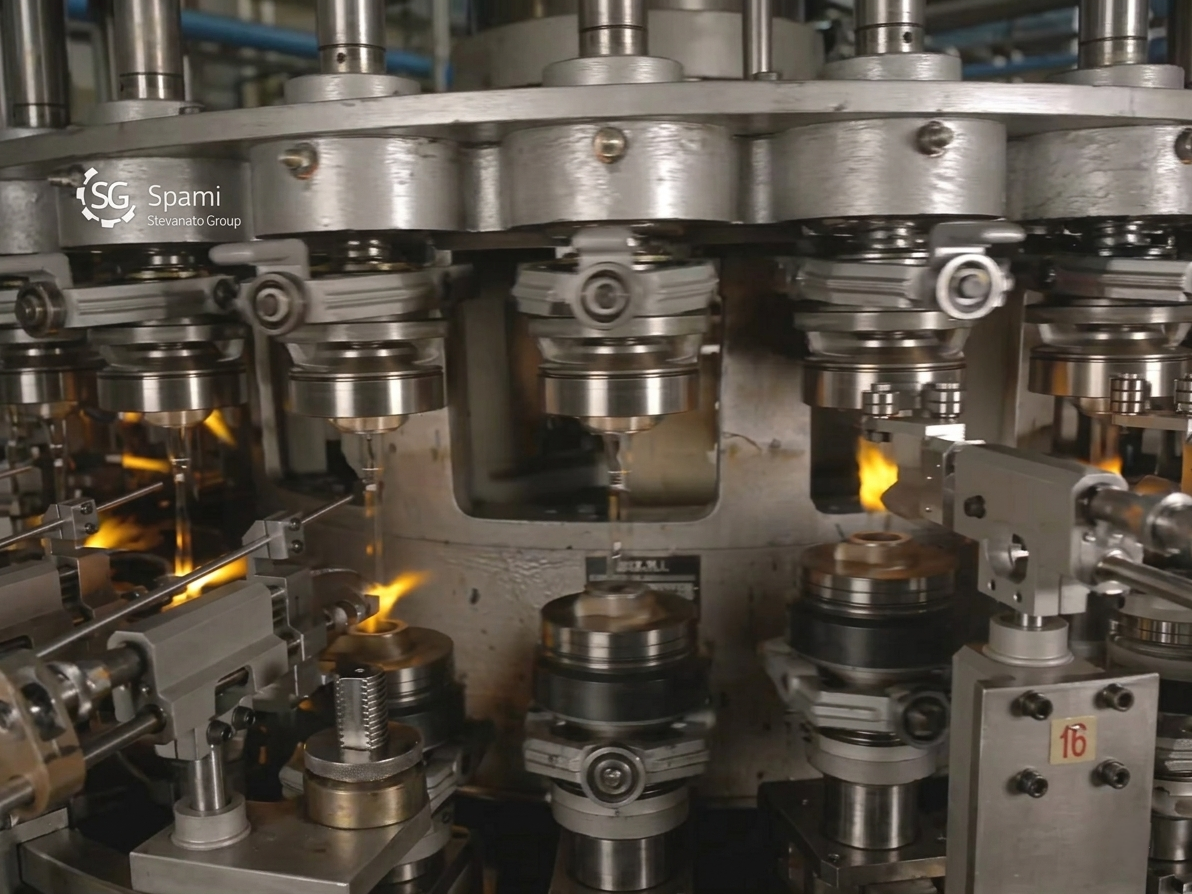
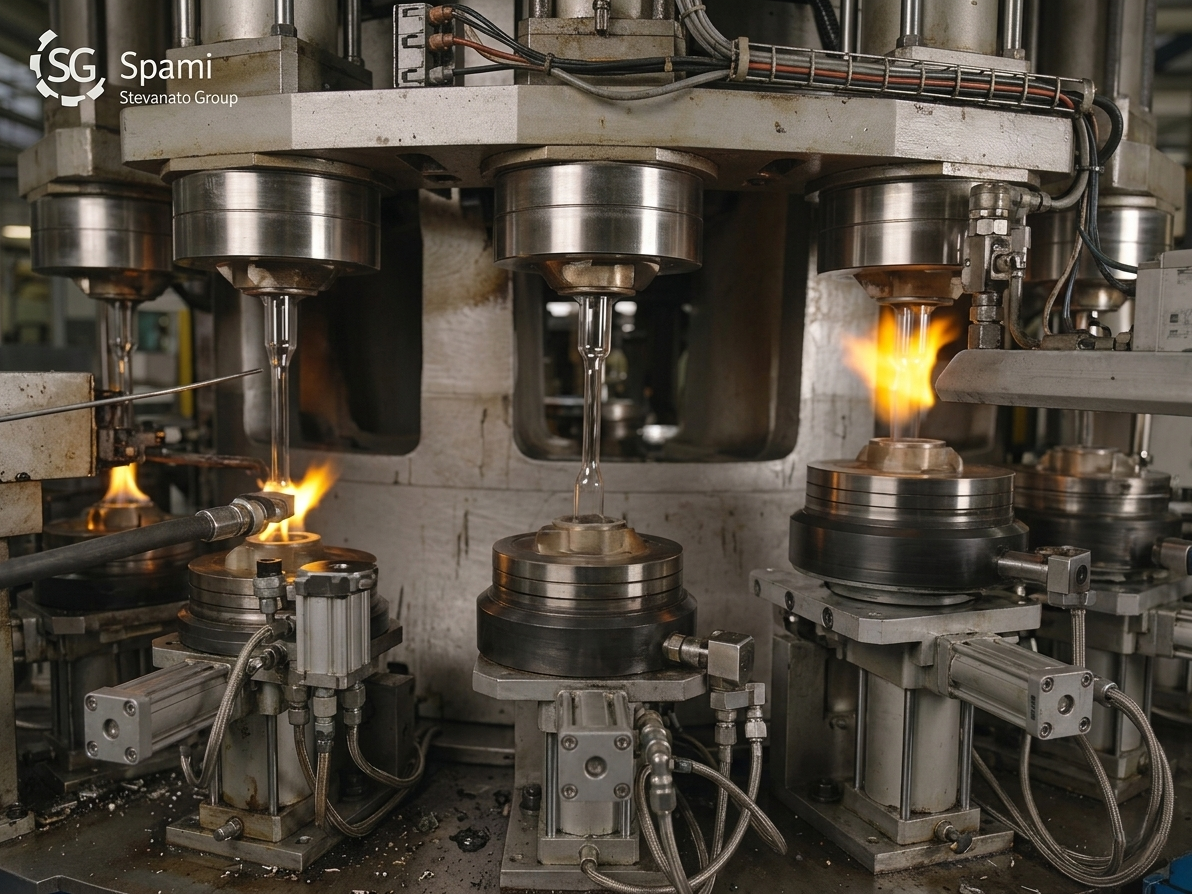
The process is typically carried out on rotary hot-forming machines, where glass tubes are held vertically in holding chucks distributed around a turntable and indexed step-by-step past a series of gas burners and forming stations. At each station the glass, softened locally by the flame, is shaped using rollers or forming tools while the tube continues to rotate on its axis, ensuring a uniform, symmetrical geometry.
Once the neck has been formed at one end of the tube, the semi-finished piece is transferred to a subsequent station (sometimes a separate "bottoming machine") where the tube is heated, drawn and separated to form the vial's base, either flat or rounded, and a new closed bottom is simultaneously prepared on the remaining tube for the next vial.
The finished vials are then typically inspected, often through non-contact vision systems, to verify neck geometry and dimensional accuracy before being sent to downstream washing, sterilization or packaging operations."
Processo utilizzato per la produzione di fiale e boccette.
Un tubo di vetro viene riscaldato e sagomato con utensili di forma.
Prima si forma il collo e l’imboccatura e poi si forma il fondo e la boccetta viene separata dalla porzione di tubo rimanente.
Il processo viene tipicamente eseguito su macchine rotative per la formatura a caldo, nelle quali i tubi di vetro vengono tenuti in posizione verticale da pinze di serraggio distribuite lungo una tavola rotante e fatti avanzare a passi successivi davanti a una serie di bruciatori a gas e stazioni di formatura. In ciascuna stazione, il vetro, rammollito localmente dalla fiamma, viene sagomato mediante rulli o utensili di formatura, mentre il tubo continua a ruotare sul proprio asse, garantendo una geometria uniforme e simmetrica.
Una volta formato il collo a un'estremità del tubo, il semilavorato viene trasferito a una stazione successiva (talvolta una macchina separata, detta "bottoming machine") dove il tubo viene riscaldato, stirato e separato per formare il fondo della fiala, piatto o arrotondato, e contemporaneamente viene predisposto un nuovo fondo chiuso sul tubo residuo per la fiala successiva.
Le fiale finite vengono quindi generalmente ispezionate, spesso mediante sistemi di visione senza contatto, per verificarne la geometria del collo e la precisione dimensionale, prima di essere avviate alle successive operazioni di lavaggio, sterilizzazione o confezionamento.
Manufacturers
Schott, Stevanato
Manufacturers
Schott, Stevanato