Intellectual Property
From the perspective of continuous innovation, Intellectual Property serves a dual function: on one hand, it is a tool for recognising the value generated by R&D investment; on the other, it is a source of strategic knowledge, because analysing third-party filings (competitive intelligence, freedom to operate, technology mapping) makes it possible to anticipate trends, players and technology trajectories in a sector.
What intellectual property is, and what it is for
Intellectual property (IP) is the set of rights that recognise and protect creations of the human mind applied to intangible assets: technical inventions, distinctive signs, creative works, confidential information. It does not protect an idea as such, but its concrete expression or solution, granting the person who developed it a temporary and territorial exclusive right, in exchange for the public disclosure of the underlying knowledge.
From the perspective of continuous innovation, IP is above all a tool for capturing the value generated by R&D investment: it allows those who developed a solution to gain an exclusive competitive advantage for a defined period, before it becomes common knowledge.

Main forms of protection
Patent for invention
It protects new technical solutions to a technical problem, meeting the requirements of novelty, inventive step and industrial applicability. The primary tool for protecting products, processes and highly innovative solutions.
Utility model
It protects improvements that give machines, tools or everyday objects greater efficacy or ease of use, without the level of inventive step required for a patent. Faster and cheaper.
Design
It protects the outward appearance of a product: lines, contours, colours, shape, surface texture, materials. Complementary to a patent when the technical component is not the core of the innovation.

Other
Beyond the three "core" forms: trademark (distinctive signs, 10 years indefinitely renewable, Nice Classification), copyright (creative works, automatic protection, life of the author plus 70 years) and trade secret/know-how (protected for as long as it remains genuinely secret, no predefined duration, no filing required).
Geographic Scopes of Protection
The three routes are not mutually exclusive alternatives: they are often combined in sequence within the same filing strategy.
WO · International route (PCT, WIPO)
This is not an industrial property title: it "freezes" the priority date and postpones the choice of countries by up to 30-31 months. It comes with an International Search Report (ISR) and a written opinion. Patents only.
EP · European regional route (EPO)
A single filing and examination procedure; once granted, it results in a bundle of national patents or the Unitary Patent, available since 2023.
NAT · Direct national route (e.g. UIBM)
The fastest and cheapest route for one or a few countries; the only route available for the utility model, which does not exist as a unitary European title.
Patent research as a tool for strategic knowledge
From the perspective of continuous innovation, Intellectual Property serves a dual function: on one hand, it is a tool for capturing the value generated by R&D investment; on the other, it is a source of strategic knowledge, because analysing third-party filings (competitive intelligence, freedom to operate, technology mapping) makes it possible to anticipate trends, players and technology trajectories in a sector.
A pillar of the method
The methodological approach that characterises the work of the Advanced Design Unit at the Department of Architecture, University of Bologna, integrates seven areas of expertise active throughout the entire design process:
- systemic reading of supply chain relationships (Systemic design),
- anticipating scenarios and steering transitions (Advanced design),
- guiding responsible behaviours and practices (Transition design)
- assessing environmental, economic and social impacts (Sustainability Assessment),
- physically validating concepts (Prototyping)
- verifying production processes (Industrial Compliance)
- patent research and the definition of protection strategies (Intellectual Property)
In this context, intellectual property, understood as patent research and the definition of a protection strategy, is a founding part of the design method. Mapping existing filings guides technical choices from the concept stage, checking freedom to operate avoids investing in solutions already covered by third parties, and analysing the state of the art supports decisions on what and how to protect as the solution takes shape.

Understanding innovation trajectories through patent research
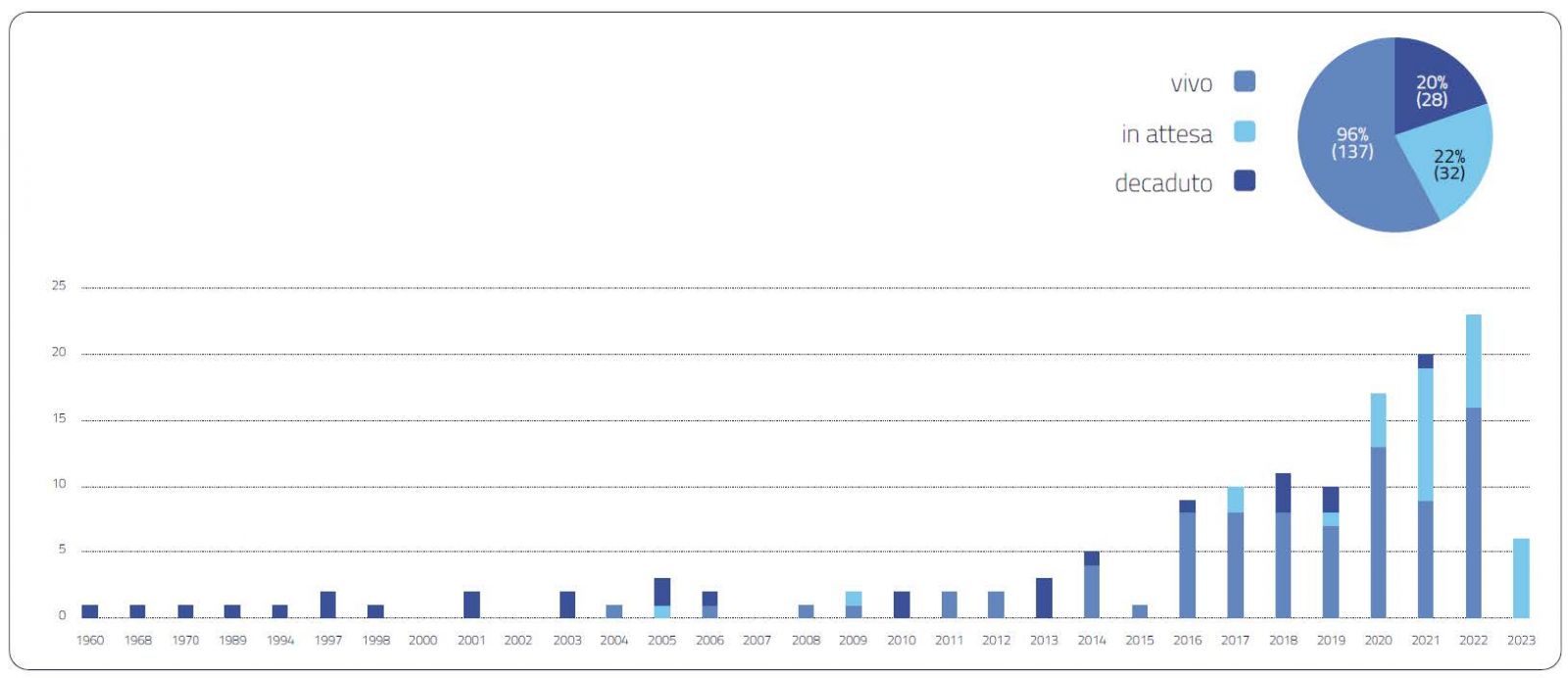
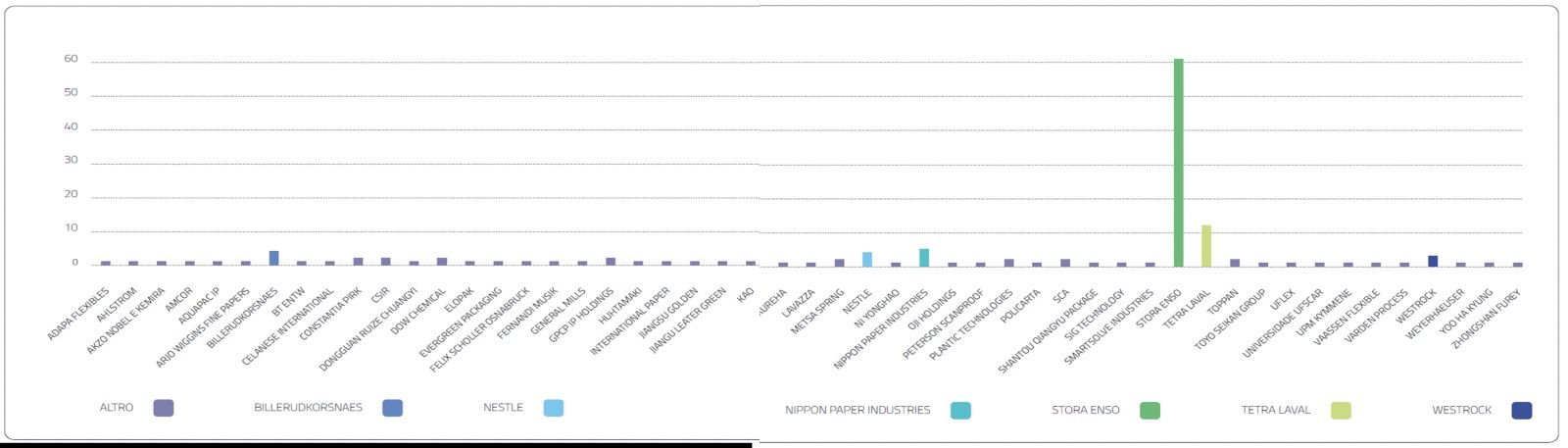
The example of barrier papers for food packaging, analysed by integrating Data-Driven tools and Advanced Design methods, shows how patent research makes it possible to read a technology scenario along three complementary parameters:
Temporal evolution of filings. The distribution of filings over the years highlights the moments of accelerated innovation and distinguishes exploration phases from phases of technological consolidation. It is extremely important to note that the 18-month confidentiality period for patent applications does not undermine this approach: given the pace at which filings evolve in a sector, this gap does not prevent trends from being captured in time and the most promising innovation directions from being anticipated before they become evident on the market, thereby guiding the choice of the best protection strategy to adopt.
Technologies involved. Classifying patents by technical solution identifies the prevailing development directions and the niches that are still under-explored.
Reference players, current and emerging. Mapping applicants distinguishes established players (paper mills, long-standing Brand Owners) from new entrants, signalling where competition is shifting.