
E-commerce
E-commerce has brought about a profound transformation in the packaging sector, influencing every stage of the process, from design to logistics. Packaging is a crucial point of contact between digital platforms, physical products and the sustainability challenges posed by last-mile delivery.
E-Commerce: a constant evolving system
In recent years, e-commerce has transformed the way consumers and businesses interact. In Italy alone, more than 33 million people purchased online in 2022, generating over 127 million transactions in the first quarter (+45.7% compared to 2019). This growth has resulted in around 31.5 million parcels per month, showing how logistics have become increasingly complex. Online shopping is no longer a marginal phenomenon but a daily practice that reshapes urban distribution, warehouse management, and consumer behaviour. Alongside this expansion, challenges linked to sustainability have emerged. The demand for fast and customised deliveries increases pressure on transport systems, with consequences for pollution and urban congestion. At the same time, companies are required to lower their environmental footprint by adopting strategies to cut emissions, optimise returns, and propose less polluting delivery options. Digitalisation accelerates this transition, offering tools to monitor emissions and introduce circular economy practices. In this context, e-commerce becomes a laboratory for innovation: not only a sales channel, but also a space to test more responsible business models, closer to consumer expectations.

The role of Packaging in E-Commerce
Packaging has become a central element in the online shopping experience. It is the first and often the only physical contact between the customer and the merchant, performing a dual function: protecting products and communicating brand values. Well-designed packaging reduces storage, shipping, and return costs, while strengthening perceptions of quality and environmental responsibility. For consumers, packaging today represents a marker of sustainability: more than 90% of e-commerce orders are shipped in corrugated cardboard, a material that in Italy has achieved a recycling rate of over 85%, already exceeding European targets set for 2030. Companies are investing in eco-design, developing monomaterial packaging that is easy to recycle and designed to minimise volume and filling materials. Innovative solutions include closure systems without adhesive tape and protective paper envelopes replacing plastic bubble wrap. Reuse and personalisation are also becoming strategic levers: boxes designed for returns or product storage, packages tailored to the size of the contents, and on-demand packaging produced directly in warehouses. In this perspective, packaging is not only a container but a competitive driver to make e-commerce more sustainable, efficient, and distinctive. 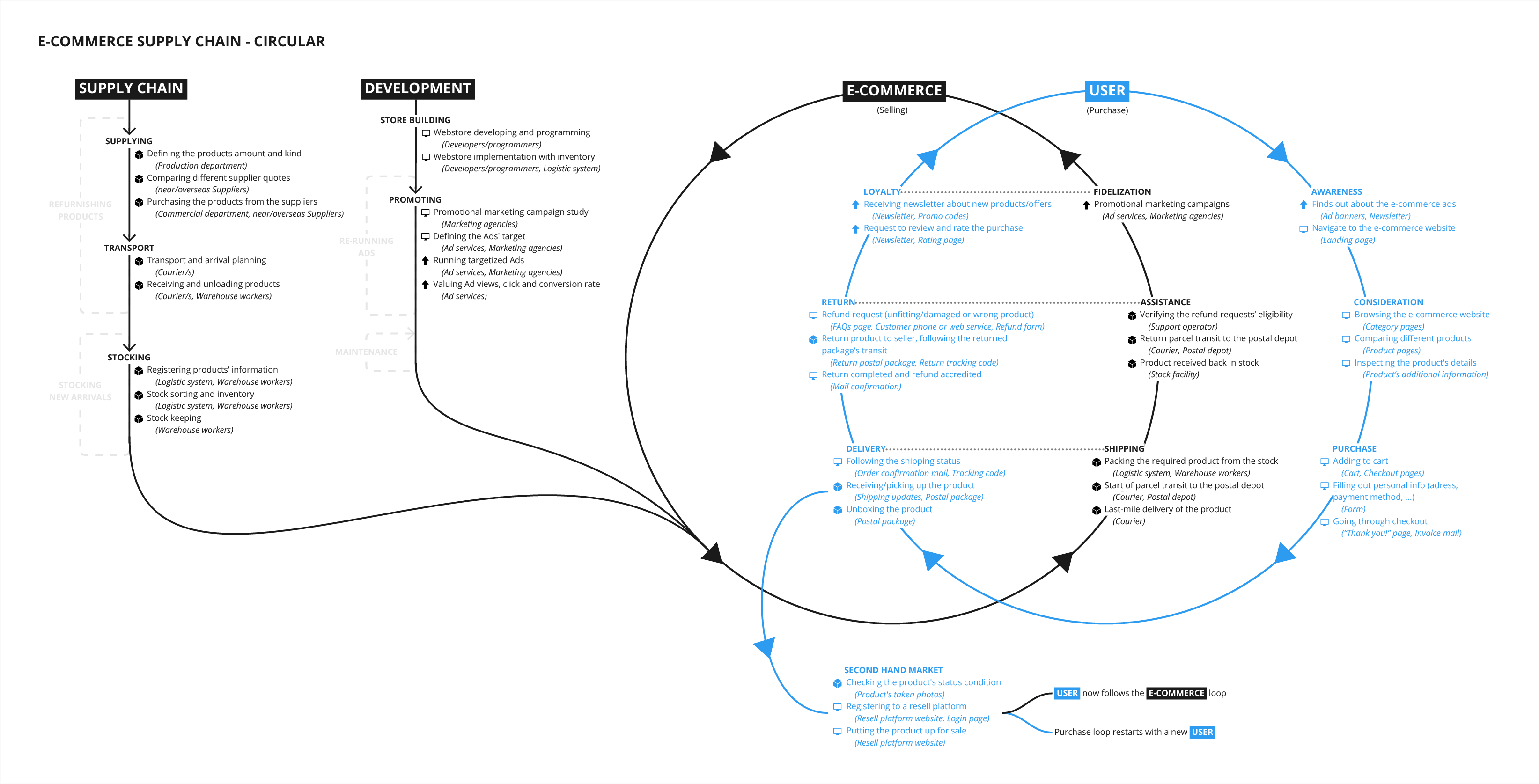
Ecommerce glossary